
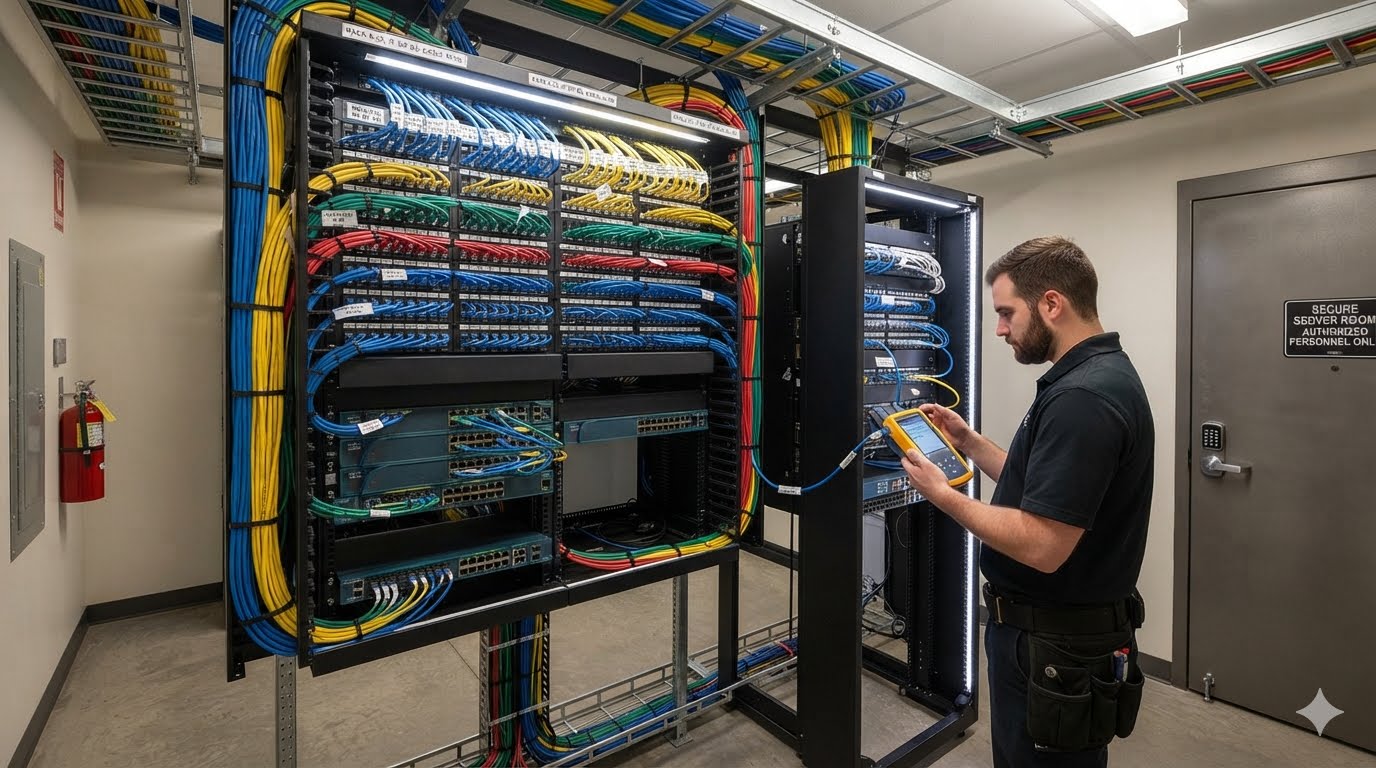
In the digital-first business landscape of 2026, reliable connectivity is just as vital as power or water. Behind every seamless Zoom call, instant database query, and cloud sync sits a complex, silent hero: structured cabling.
Rather than a chaotic “spaghetti pile” of cords, a properly engineered structured cabling framework uses a standardized, hierarchical design. This design scales effortlessly, isolates issues in minutes, and keeps data flowing smoothly. Let’s dive into the core architecture, essential hardware, and deployment best practices that separate professional networks from IT nightmares.
The Nerve Center: MDF vs. IDF
Every structured wiring deployment relies on a hub-and-spoke topology governed by two types of distribution frames: the MDF and the IDF.
-
-
Main Distribution Frame (MDF):
- Think of the MDF as the primary nerve center of your building or campus. This is the central point where external service providers (ISPs) terminate their connections into your facility—a boundary known as the demarcation point. The MDF typically houses core routers, primary database servers, central switches, and security gateways. If the MDF goes down, the entire organization goes offline.
-
Intermediate Distribution Frame (IDF):
- Standard copper ethernet cables (like Cat6 or Cat6A) degrade in signal performance after 90 meters (295 feet). To overcome this physical distance limit in large or multi-story buildings, installers deploy IDFs. An IDF acts as a localized satellite closet on a specific floor or department. It gathers the cables from nearby workstations onto its local switches and sends that bundled data back to the central MDF via high-speed, fiber-optic “backbone” links.
-
The Equipment Skeleton: Racks and Component Management
To house delicate networking equipment securely and efficiently, engineers rely on standardized framework hardware.
-
-
Server and Network Racks:
- Hardware is securely mounted onto heavy-duty steel or aluminum racks. These are measured vertically in “Rack Units” (U), where 1U equals 1.75 inches. While enclosed four-post server cabinets are common in central MDFs for security and deeper equipment support, two-post open-frame racks or compact wall-mounted cabinets are frequently used in IDFs to save floor space.
-
Patch Panels:
- Never plug solid-core horizontal copper lines directly into a dynamic network switch. Instead, those building cables terminate permanently onto the back of a patch panel. Short, flexible stranded-core patch cords are then used on the front of the panel to route connections directly to the switches. This system protects your permanent building wires from wear and tear.
-
Horizontal and Vertical Cable Managers:
- Clean dressing isn’t just about aesthetics; it maintains proper cooling airflow. Installers use horizontal D-rings, vertical wire trays, and reusable Velcro straps to bundle cables securely without creating tight bends that can pinch internal copper twists and degrade performance.
-
Strict Quality Standards: Labeling and Testing
A structured cabling deployment is only as dependable as its installation quality and documentation.
-
-
Standardized Labeling:
- Every single drop needs a distinct identifier mapped onto both ends of the cable, the patch panel port, and the wall jack in the office. Professional installers typically follow the ANSI/TIA-606-C standard (e.g.,
MDF-P1-04meaning Main Frame, Patch Panel 1, Port 4). This eliminates guesswork during troubleshooting. -
Rigorous Testing:
- Once cables are crimped and punched down, they must be validated using specialized testers. Simple continuity tests only check if the pins connect. Advanced Fluke certification testers measure parameters like near-end crosstalk (NEXT), return loss, and attenuation to guarantee that a line can actually achieve its rated 10Gbps or 2.5Gbps speed threshold without data packet drops.
-
Fortifying the Infrastructure: Securing the Rooms
Since your entire corporate data stream funnels through these closets, physical security is non-negotiable.
-
-
Access Control:
- MDF and IDF rooms should never double as janitorial closets or general storage spaces. Keep doors strictly locked with electronic access control systems (such as biometric scanners or smart keycards) that maintain an audit log of precisely who entered the room and when.
-
Environmental Control & Monitoring:
- Switches, servers, and Uninterruptible Power Supplies (UPS) generate significant heat. Dedicated HVAC cooling systems are required to maintain temperature and humidity parameters to prevent hardware burnout. Pair these with networked environmental sensors that send immediate SMS or email alerts to the IT department if a room begins to overheat or experiences moisture accumulation.
-
Investing in a robust, standardized structured cabling topology guarantees that as your organization scales, your foundational infrastructure will remain rock solid for years to come.