
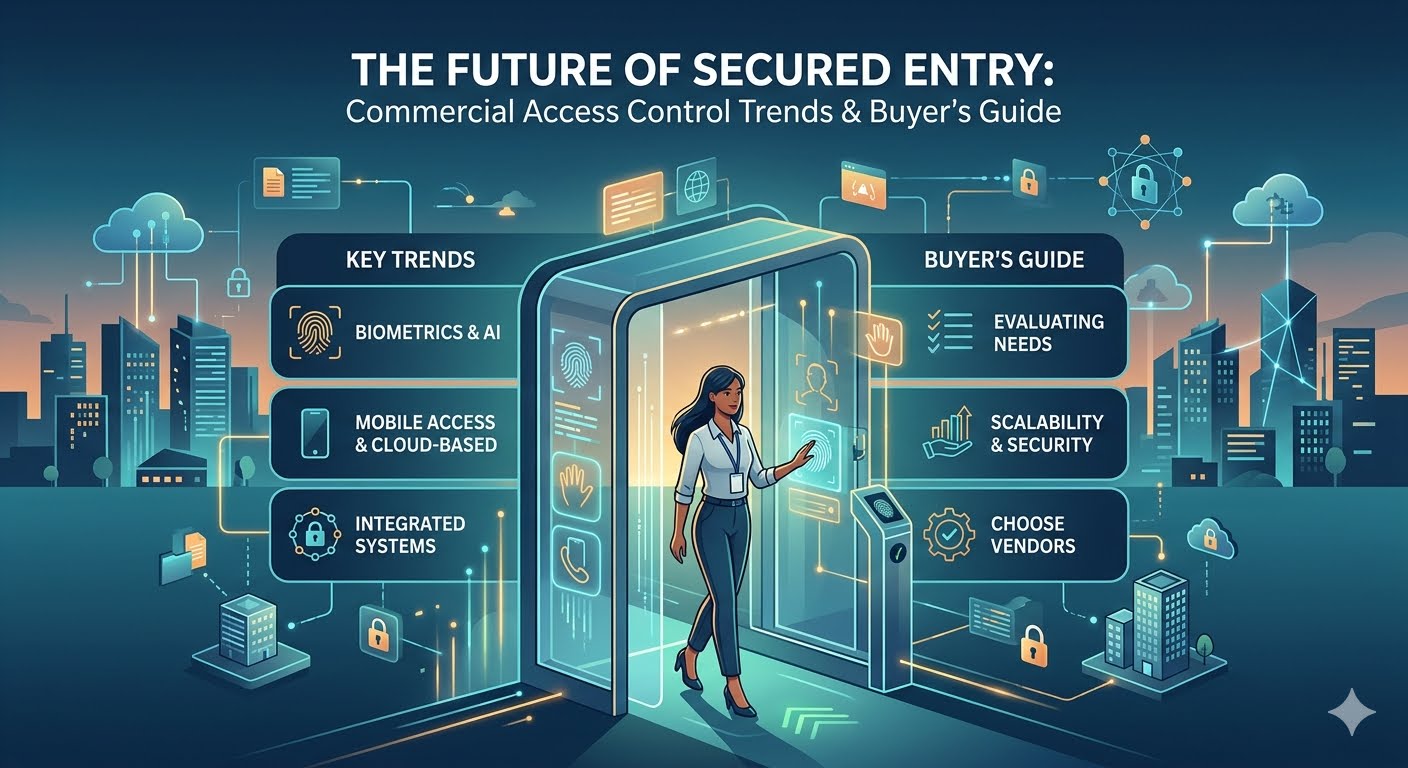
The Future of Secured Entry: Commercial Access Control Trends & Buyer’s Guide
Cloud-based infrastructure, mobile credentials, and biometric authentication are the leading access control trends driving the commercial security market. Modern commercial facilities are rapidly transitioning away from legacy, siloed hardware. Instead, they are adopting interconnected systems that mitigate risk, automate operations, and adapt to shifting workforce dynamics.
Whether you are securing a single technology room or managing an enterprise campus, understanding these technical shifts and their lifetime operating costs is vital before signing a contract.
🚀 Top Commercial Access Control Trends
1. Cloud-Based Systems (ACaaS)
Access Control as a Service (ACaaS) eliminates the need for expensive, high-maintenance on-premise servers. Administrators can manage multi-site user permissions, review entry trails, and adjust door schedules remotely using any secure web browser or mobile app.
2. Smartphone & Mobile Credentials
Physical keycards and key fobs are being replaced by secure smartphone credentials. Leveraging Bluetooth Low Energy (BLE) and Near Field Communication (NFC), employees can unlock doors through specialized applications. This eliminates the continuous expense of replacing lost or broken physical badges.
3. High-Accuracy Biometric Integration
Advanced touchless technologies, including facial recognition scanners and iris readers, are moving into the mainstream for high-security zones. These tools remove the risk of credential sharing, creating a definitive, unforgeable audit trail.
4. Unified Security Ecosystems
Modern access systems no longer sit in isolation. Leading platforms natively integrate with building automation, HR onboarding databases, and IP video surveillance cameras, pulling all emergency data into a single, cohesive interface.
💰 Upfront vs. Monthly Operating Costs
Implementing commercial access control requires balancing a one-time capital investment with predictable ongoing operational expenses.
Upfront Capital Costs
A standard single-door commercial deployment—including an electronic locking mechanism, an intelligent controller panel, a multi-technology reader, and professional installation labor—typically averages $2,500 to $4,500 per door. High-security biometric setups can easily push initialization costs from $3,500 to $6,500 per door due to advanced sensor hardware.
Average Monthly Operating Costs
For cloud platforms, software licensing fees are typically structured on a per-door grid:
- Standard Cloud Tier: $10.00 to $20.00 per door, per month for baseline remote monitoring, standard schedules, and audit logging.
- Advanced Enterprise Tier: $15.00 to $25.00+ per door, per month when incorporating real-time AI anomaly detection, extensive multi-system integrations, or massive user databases.
🛠️ The Crucial Importance of a Maintenance Contract
An access control system is an active infrastructure network that experiences physical friction every single day. Neglecting system care exposes your enterprise to sudden mechanical breakdowns and costly regulatory violations. Securing a SLA (Service Level Agreement) or Preventive Maintenance Contract is vital for several key reasons:
- Hardware Longevity: Routine technical cleanings, alignment tests on magnetic locks, and network switch updates prevent premature gear deterioration.
- Battery Fail-Safe Audits: Access systems utilize backup battery power to maintain building security during municipal grid blackouts. Routine professional checks ensure emergency backups function flawlessly when needed.
- Predictable Security Budgeting: Emergency technician dispatches, unexpected replacement parts, and rush labor fees are expensive. An active contract converts volatile repair costs into a structured, predictable annual operating expense.
- Firmware & Cybersecurity Patches: Modern entry points are active IoT network devices. Regular software maintenance contracts guarantee your system gets immediate updates to patch firmware vulnerabilities and ward off cyber threats.
📋 5 Critical Questions to Address Before Purchasing
Before finalizing a deal with a security integrator, make sure your team reviews these key functional parameters:
- Does the system operate on open hardware standards, or is it entirely proprietary? Choosing non-proprietary hardware protect your investment, letting you swap software vendors down the road without tearing out every physical lock and panel.
- How does the system function during a total network or internet outage? Confirm the door controllers store credential databases locally so your building remains safe and accessible even if connection to the cloud drops.
- What are the local fire codes and emergency egress requirements for our building type? Fail-safe electronic locks must instantly cut power and open during fire alarm triggers to guarantee safe, legal occupant evacuation.
- How does the pricing scale as our footprint or workforce expands? Verify if the platform charges licensing fees strictly per door, per active user, or via a flat infrastructure bracket.
- Can the platform integrate cleanly with our existing IT identity management systems? Automating user provisioning through services like Microsoft Entra ID or Okta saves your HR team hours of administrative work by instantly updating building access privileges during employee onboarding or offboarding.